

To Hamlet, or not to Hamlet, that is the question
- May 18, 2021
- 8 min read
To Hamlet is the answer

Well, well, well. Where do I even begin? I mean, there’s just so much to talk about. I guess there’s technically a limit to all things in this world, but I don’t think I could fit all the things about Hamlet into this little blog post, even with the lengthy page minimum that I’m required to fulfill. It’s kinda like a Las Vegas buffet: there’s so many options, so many good appetizers, entrees, drinks, desserts, etc. to choose from, yet there’s only so much your stomach can really take before your neighbors start complaining about how they can smell your toilet two blocks down the street. There’s only so many things I think I would be able to write about regarding Hamlet and its profound impact that resonates across the globe, so I’m only going to try and pick and choose the more prominent things. The ones that are (probably) most prominent to most people, the ones that are the featured item in a long array of selections. To go on and on about the other things that, while interesting, are less relevant to people’s lives would essentially be the equivalent to eating way too much food at the buffet and thus ensuring that your neighbors call for your house to be decontaminated. In other words, it’s pretty counterproductive to keep going on and on. Therefore, I’m going to finally end this intro to my introductory paragraph right here, and hopefully that will be the end of my poopy toilet jokes.
There’s plenty of reasons as to why Shakespeare is still studied in schools today. Heck, it often even feels like Shakespeare is overstudied to many people, and for the most part that kinda includes me. However, regardless of whether I and my fellow classmates like studying Shakespeare or not, that doesn’t negate his impact on pretty much everything that goes on today. It’s kind of like a boxer who obviously despises his opponent but absolutely has to respect his opponent’s game unless he wants to get knocked out. You have to acknowledge the impact that Shakespeare has had on things like modern culture. His impact rings out through society whether we’re aware of it or not. In a way, Hamlet is a microcosm of Shakespeare’s reverberations throughout our lives. What sets Shakespeare’s finest play apart from his other extraordinary literary works is the longevity of its impact. There’s iconic, timeless bits as well as modern works that wouldn’t exist at all had Hamlet never been written. Though Hamlet was first performed over 400 years ago, its reverberating shockwaves still show themselves, both behind the scenes and in the spotlight, in our modern culture today.
I’m going to start a little “smaller” and begin by talking about the things that make Hamlet so relevant to our lives today. Let’s start with the mini-elephant in the room: the iconic quotes. There is a pretty good reason as to why Hamlet is such an incredibly popular “source for allusions and familiar lines” (Rebecca R). Shakespeare has produced plenty of rather well known (and memeable) quotes in general, but Hamlet seems to have an abnormally large number of these quotes, even for a Shakespeare work. There is this one quote that makes for some pretty funny meme…
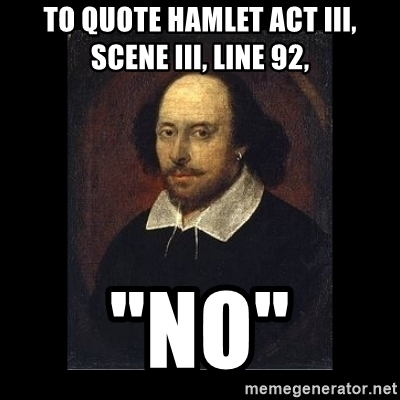
… and then there’s a few that end up plastered on the walls of every English classroom in the world.

I’m not going to pretend like that first quote is anything special, but I think saying that “To be, or not to be” (Shakespeare 147) is in every English classroom is a little bit of an understatement. I mean, my goodness, it’s everywhere (though in a weird Mandela effect moment, I never remembered the comma being there until I looked up the actual quote). I actually have another confession regarding this: I never actually knew that that quote came from Hamlet until I began reading it. People like me probably began hearing Hamlet quotes before even knowing what Hamlet was. It’s that iconic. “To be, or not to be” (Shakespeare 147) kicks off perhaps the most well-known speech/soliloquy in the history of the world as Hamlet contemplates and juxtaposes the matter of life and death. It’s something that people can certainly relate to, even if only due to the never ending curiosity of what death may be like. It may be written in old English, but it’s still powerfully worded and incredibly memorable as a result of its writing and subject matter.
Another bit that I thought I’d touch on was the relatively relatable theme of revenge that is also quite prominent in Hamlet. For those that have siblings, there has most definitely been at least one time where you got pretty angry and wanted to exact some form of revenge upon them. I mean, when your younger brother takes your dino nuggets and gets away with it, who wouldn’t at least be a little angry? Of course, the circumstances regarding Prince Hamlet’s revenge are a little more severe than food theft, but it does convey some notable points regarding revenge nevertheless. There’s several ways to look at it, but they all seem to have something to do with the morality of revenge which is something that people could debate all day about. Holly Crocker writes that Hamlet demonstrates how revenge makes people “lose what made [them] good in the first place” (Crocker), or in essence make them become what they seek to destroy. There’s certainly glimpses of this where Hamlet struggles with following through on his quest to avenge his father, and it certainly brings the debate on revenge’s morality to center stage. Revenge is a pretty common theme in works from all periods of literature and entertainment, but you don’t often find it constructed as well as it is in Hamlet. The emphasis on revenge is one that is likely to be of interest to almost anyone in the audience.
Hamlet wouldn’t be regarded anywhere near as highly as it is today if it wasn’t a timeless piece that allows it to be memorable even in a new era that seems to dust away the things of the past. Even with all the thee’s and the thou’s that are no longer used (unless it’s a TokTok making fun of the 1400’s), Hamlet presents issues and conflicts that, in one way or another, are ultimately something that the audience can relate to and invest in.
Did thou thinketh that Hamlet showeth thyself only in thy Anglo-Saxon of thy past? Well think again. Hamlet certainly makes appearances in many, many modern day works, whether they be literature or movies or whatever other media of entertainment there is. Hamlet makes appearances as both cameos and as the lead actor, and there’s plenty of examples of both. I’ll start with some cameos. In The Empire Strikes Back, Chewbacca holds the head of C-3PO in a way that very much resembles how Hamlet holds the skull of Yorick in most productions (“Cultural References to Hamlet”).

Anytime Hamlet gets quoted is another cameo appearance to Hamlet’s name. There’s also many times where Hamlet is pretty influential on a work as a whole, beyond the occasional reference or two. This kind of applies to Shakespeare as a whole, but man, Shakespeare really does love killing off all of his characters. He did this way before it was cool, and he kind of became a bit of a trendsetter with this whole character house-cleaning thing.
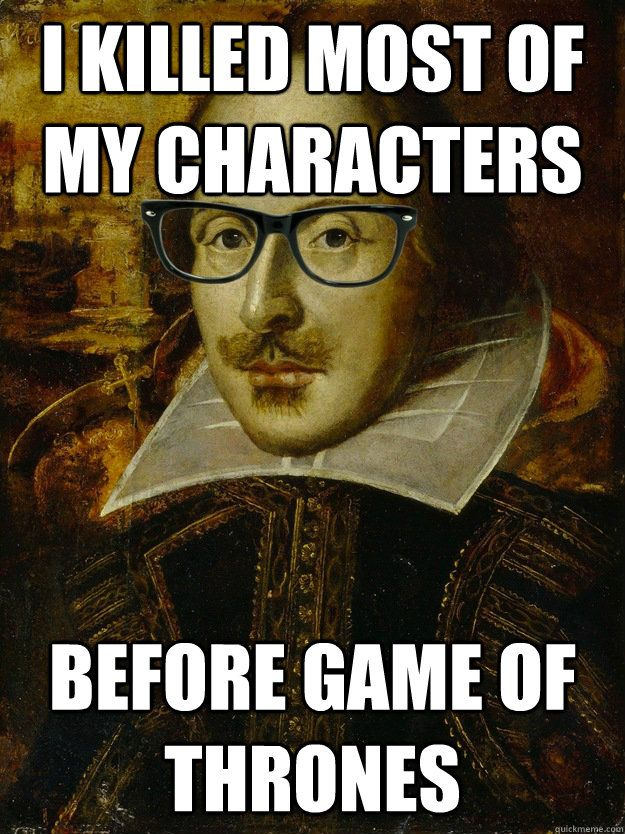
(Just a note, I have not actually watched Game of Thrones so I’m just hoping that this meme is correct.)
Hamlet has impacted so many notable works that are mainstream culture mainstays (or at least ones that had a considerable period of time in the spotlight). But, at least as far as I can tell, none of this even compares to this one modern work that is basically Hamlet with a happy ending. If you’re a Lion King stan, you might just want to look away now.

The Lion King essentially lifts a lot of things from Hamlet, whether they be plot elements, themes, et cetera. It’s probably a good thing for The Lion King that Shakespeare lived a long time ago and thus his works are now in the public domain. It’s also a good thing for The Lion King that they decided to copy perhaps the greatest play ever written (and if it isn’t, it’s definitely up there). I mean, if you’re going to copy someone’s homework, you probably want to copy the smart kid that’s going to get an A+, right? That’s pretty much what The Lion King did, and it ended up becoming one of the greatest animated movies of all time. One of the greatest plays of all time resulted in one of the greatest animated movies of all time. Funny how that works out eh?
It may somewhat sound like I’m dissing The Lion King a little bit here, but believe me when I say I don’t hate it. In fact, as I mentioned above, it’s easily something that I personally would consider a classic (and I know that many others agree with me on this). The Lion King’s basis in Hamlet is actually what makes it as good as it is. Plot wise, there are many similarities with regards to protagonists, villains, story flow, etc, and especially the family issues. The only real difference in plot is that we get a classic Disney happy ending in The Lion King that obviously would never happen in a Shakespearean tragedy. But there’s a lot more beyond just the plot that’s similar. There’s the similarities in the themes (no doubt helped by the many similarities in plot) that both works address regarding power, greed, revenge, amongst others that I’m not going to discuss in this article for the sake of not writing a 200 page novel. Scar and Claudius become evil uncles and kill their respective brothers and become king, taking their brother’s wives as their queen (this is only implied in The Lion King, likely for the sake of making it more kid-friendly) in their quest for power (McElveen). Simba and Hamlet both try to avenge their fathers to some degree, and both do end up succeeding, although Hamlet doesn’t live to tell the tale himself. There’s even similarities in how both works deal with indecisiveness and responsibility and the drastic negative consequences these two things combined can lead to. Simba has a period of time where he’s contemplating whether to return to the Pride Lands, which is kind of a more G-rated version of “To be, or not to be.” The main characters also show unwillingness to directly kill their uncles, at least at first, leading to more danger for both Simba and Hamlet. Heck, who knows, Hamlet might have lived had he decided to just kill Claudius while he was praying. The similarities between Hamlet and The Lion King are astonishing, and as a result, both are considered all-time classics for all ages. They contain similarly relevant themes for many people and mix it into similarly entertaining plots, allowing both works to truly withstand the test of time.
The legacy of Hamlet cannot be understated. If Shakespeare ever could outdo himself, he would have done it with Hamlet. When it comes to choosing what to read, I normally like to read the shortest options available, and Hamlet certainly is not the shortest Shakespeare work I could’ve chosen. I’m glad I did, though. Reading Hamlet has allowed me to see what has driven the permanence of Hamlet and the incredible impact that Hamlet has throughout our culture today. No matter what happens in the future, I’m pretty sure Hamlet will be a part of it.
Works Cited
Crocker, Holly. "The Hamlet Effect." Arcade, 20 Apr. 2015, arcade.stanford.edu/blogs/hamlet- effect. Accessed 29 Apr. 2021.
"Cultural references to Hamlet." Arts and Popular Culture, www.artandpopularculture.com/References_to_Hamlet. Accessed 2 May 2021.
McElveen, Trey. "Hamlet and The Lion King: Shakespearean Influences on Modern Entertainment." The Lion King WWW Archive, 17 Apr. 1998, www.lionking.org/text/Hamlet-TM.html. Accessed 3 May 2021.
R, Rebecca. "Hamlet Shows Shakspeare's Long-Lasting Cultural Effect." Much Ado About Shakespeare, Rebecca R, 5 Apr. 2011, shakespearefiorenza.blogspot.com/2011/04/hamlet-shows-shakspeares-long-lasting.html. Accessed 3 May 2021.
Shakespeare, William. Hamlet. 1609. Apple Books ed., Bookbyte Digital, 2011.


Comments